
Sports journalist Sam Petherick interviewed me about my approach to teaching swimming. Listen to the clip here. http://
“I am the water”
 In my swimming classes I often get the children to play a game where they have to imitate something you find in the water and the others have to guess what it is. We’ve had loads of jelly fish, mermaids, dolphins, an island, sand, stones and various other things. The other day one little girl was wriggling along in a way that could have been interpreted as almost any of the things above. We guessed and guessed but no one could get it. In the end we gave up and she said
“I am the water.”
She was being the actual water itself.
Genius.
Half of primary school aged children can’t swim
 A report out this week shows that partly due to poor provision of swimming lessons in schools more than half of 7 – 11 year olds in the UK can’t swim.
At last
 This song has nothing to do with swimming but it is a beautiful song sung, beautifully, by my beautiful niece Ruby. The song was written by Mack Gordon and Henry Warren in 1941. Blues singer Etta James covered the song in 1961 and it became her signature song.
From the Wide Sargasso Sea to Eel Pie Island
 I am always trying to think of new swimming games to play with the children I teach. One that I came up with recently was imitating things you might find in the water. Then the others in the class have to guess what you are being. They have had many and various ideas, including lots of mermaids, mermaid princesses, sharks, crocodiles, sea weed, jelly fish, an octopus, dolphins, an island, a giraffe come down to drink at the water’s edge (I said that was stretching the rules a bit), stones and even sand. I sometimes take a turn myself and almost always when I am being the thing, whatever it is, the children guess whale. (It never is whale). We rarely get fish but for some reason but the other day one little boy decided to be a fish, and he was such a wriggling kind of fish that someone guessed eel.
That got me to thinking about eels.
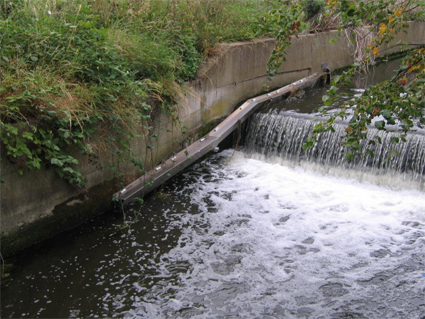
During its lifetime, the European Eel travels from the Sargasso Sea, to Europe and back again, a distance of 10,000 kilometres. Scientists are not sure exactly how they do this but it seems they use the Earth’s magnetic field to find their way. In recent years numbers of Eels in our rivers and streams have declined rapidly. There could be many reasons for this but one theory is that part of the problem could be the number of man made barriers such as locks and weirs that are stopping them from getting through.
Eels are not very pretty, or very glamorous creatures, but they are very important to us.
Eels used to be very prolific in our rivers and streams, hence the jellied eels of London’s East End, and the famous Eel Pie, of Eel Pie Island. Nowadays Eels are not so popular as a food stuff but they are very important for our environment. Eels are a keystone species. This means they have a disproportionately large effect on their environment relative to their numbers. Keystone species play a critical role in maintaining the structure of ecology and they affect many other organisms in an ecosystem, thus helping to determine the types and numbers of other species in the communities.
Eels are critical to the health of our waters and fish stocks. If the eels disappear, other species will be seriously affected. For example it seems that otters may be turning to other food sources as they can not find enough eels to eat.
Environmentalist Joe Pecorelli is heading up a new initiative, the London Eel Action Plan (LEAP), looking into eel migration. Part of this initiative is to design and build special eel bridges and passes to enable eels to navigate rivers more effectively. For more information click here
Butterfly
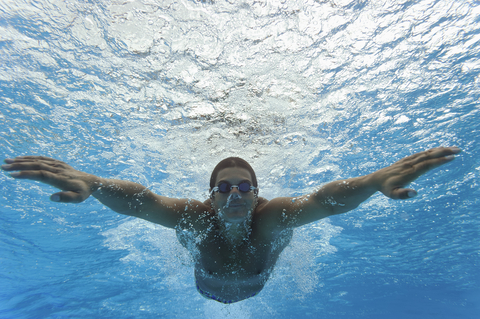 There is a view that butterfly is a very difficult, exhausting stroke, but this need not be so.
I learned to swim butterfly using the Shaw Method and from being completely unable to swim this stroke I can now manage several lengths.
Remember the key part of any stroke is the glide. In butterfly you glide as you bring your arms over your head and your body is moving forward and slightly upwards through the water.
Important points:
- the key to a good smooth butterfly is the undulation
- leading from the head, and keeping the feet together you need to ripple through the water using a dolphin kick
- the ratio of kicks to arm movements is two to one, so two kicks to one arm movement
- count one, two and on the second kick open the arms out slowly, like unfolding your wings and bring them forwards together in front of you
- let your head follow the movement of your arms and body
- breathe every other stroke
- swim slowly and evenly and you will soon build up stamina and rhythm.
Swimming and mindfulness
 Mindfulness means being consciously, deliberately aware of each moment as it passes. To me swimming and mindfulness go together. To swim well you need to use your whole body and to feel at one with the water. A good swimmer listens to the water, judging the water’s response to each movement. Swimming is a solitary activity; although you may be in the pool, lake, river or sea with many others, essentially you are alone when you swim. You are in your own private world, alone with your thoughts and feelings; your body is as close to weightless as it is possible for most of us to experience. (NASA astronauts train in deep water to simulate the experience of weightlessness) To swim well you need to regulate your breathing so that your breath is in time with your stroke; you can become aware of the breath entering and leaving your lungs. Swimming is a rhythmic activity, a kind of dance with the water and it can be a meditative experience. I have take many troubles to the water and without consciously searching for a solution, have found new ways of coping with problems that seemed insurmountable.
In the water
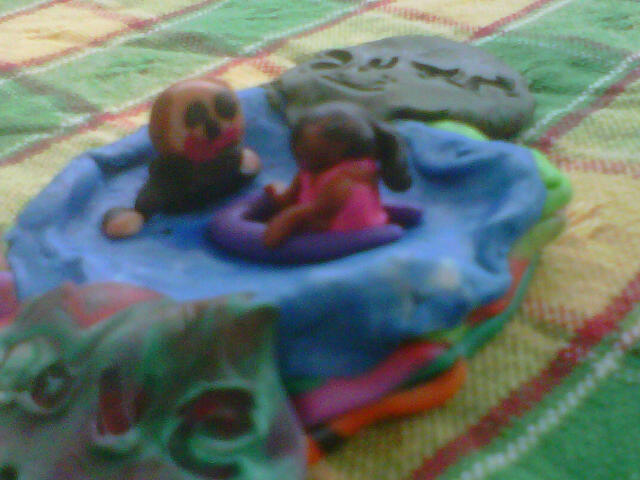 One of my little pupils made me this lovely model of me and her in the water. It was so detailed. Look at how she has put in my hands just showing out of the water, and her own arms resting on her float; beautiful.
Breaststroke
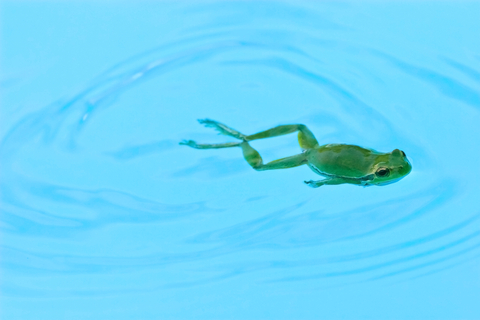 Breaststroke seems to be the most common swimming stroke, and many people see it as the easiest one, but it is also the one that is often done inefficiently. It is a badly named stroke in some ways because in breaststroke the power should come from the legs. Think of a frog. It has strong, powerful back legs and tiny feeble little arms. For most of us our legs are stronger than our arms and it makes sense to use them. But maybe because we call it breaststroke, many people use their arms to propel them forwards, which is very inefficient and makes it difficult to breathe effectively.
A strong but gentle leg kick should propel you into a smooth glide with your face in the water in order to maintain a streamlined position. Breathe out as you glide forward, then use a smallish circular arm movement to lift your head out of the water to inhale.
Add in a gentle undulation, angling your head downwards as you breath out and directing your body upwards for the in breath, and you will have a smooth, relaxing, gentle, yet powerful stroke.
Here is a good clear description of how to achieve a stress free breaststroke.
Crocs
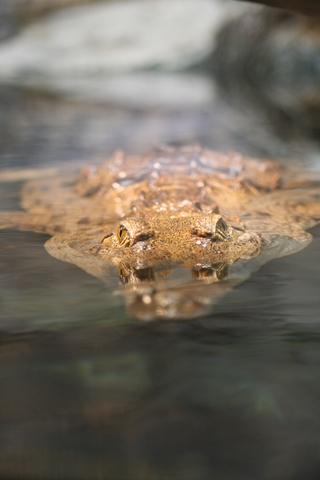
Australian freshwater crocodile
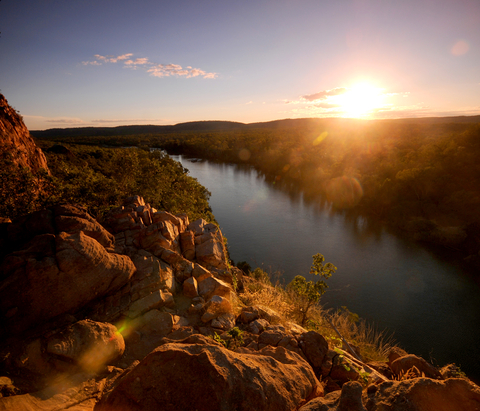
Katherine Gorge
Once upon a time I was in Katherine Gorge in the Northern Territories in Australia. The town of Katherine is set amongst a landscape of ancient limestone formations: there are pockets of monsoon rainforests, eucalypt forest, and rocky escarpments. Katherine Gorge itself is a series of thirteen gorges along the Katherine River.
The region abounds with exotic wildlife including, in the river, fresh water crocodiles. The first inhabitants of the area were the Jawoyn people and the Wardaman people for whom it was an important meeting place. Europeans arrived in about 1870 and they called the town they established Katherine, after someone’s wife.
While we were there we took a boat trip down the river. The trip was interesting but it was so hot that I almost couldn’t enjoy it. Added to which I felt incredibly thirsty and although we had water with us it didn’t seem to help. During the boat trip the guide pointed out some spiky shapes in the water, which he told us were crocodiles.
When we got back to the shore I was still very thirsty and hot and I was desperate to go for a swim. It was an absolute longing, such as I have often experienced in my life when I am near water; I almost always want to dive in, even if it is cold. I sometimes feel this when I am just walking along by the Thames; here in Katherine, in the sweltering heat it was quite overwhelming.
The only thing really stopping me was the fact that we had seen the crocodiles and I didn’t, and still don’t, know how dangerous they were. I kind of had the idea that fresh water crocodiles don’t attack humans; it is the salt water crocs that are much more likely to eat you. My longing for a swim was so great that I convinced myself that this was an absolute fact and that I was in no danger at all from these much smaller chaps. Also, I told myself, they were quite far away, nowhere near this little bit of beach we were on now.
Eventually it was too much for me and I dived in. The water was cool and lovely. I had not a thought for the crocodiles whilst I was swimming. After some minutes I swam to the shore and climbed out, unharmed and safe.
I discovered later that I had been sweating so much in the heat that my body was lacking some kind of minerals or salt or something and that was why I couldn’t seen to quench my thirst. I never have found out how dangerous fresh water crocodiles are, and if they ever attack humans, but on that day my desire for a swim outweighed all other considerations.
 mindful swimming