Jumping in

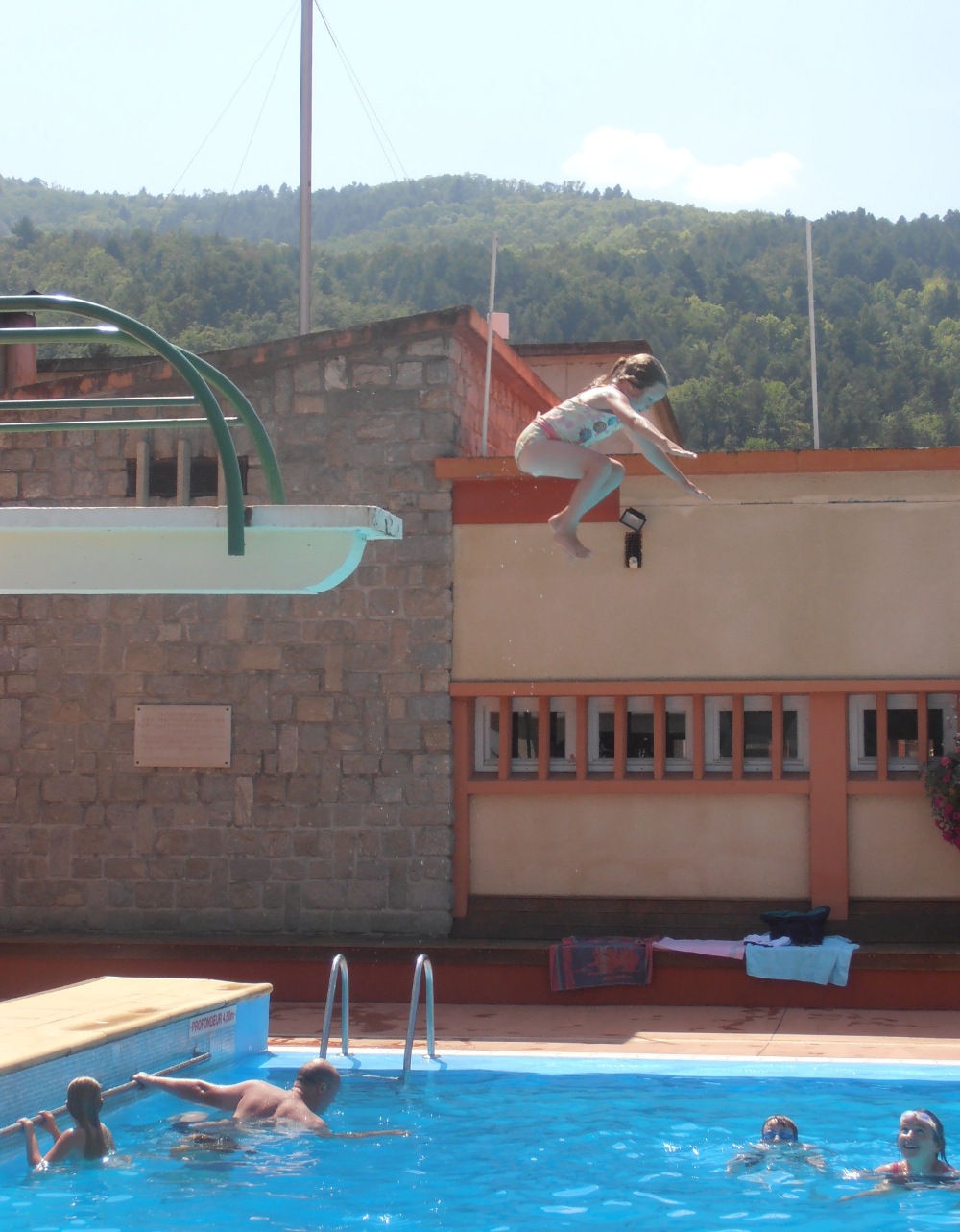
Ivy jumping in

Ivy jumping in

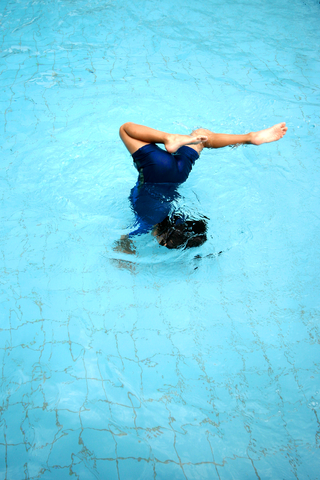
A couple of weeks ago one of my adult pupils asked me about diving and jumping into the water. He had not done this before. As the pool where we were was in a modern health club the depth was just 1.2 metres throughout. I was not sure. Technically it should be fine but I was a bit worried, not about the water, but about him hurting himself if he landed too heavily on the bottom of the pool, so we didn’t do it.

His question made me realise that it is probably years since I have jumped in.  My regular swimming pool has a deep end, this is sadly quite rare these days. Modern pools are often all one depth. It is cheaper that way as there is less water to heat. I have a very good friend who campaigned not only to keep our local pool open, but also to keep the depth. The management wanted to fill it in and make it more shallow but she fought to keep the three metre depth at one end. She won, so we have the luxury of the deep water to swim in. The diving boards were taken away, so there is nowhere to practice diving anymore, but at least we can jump in. So why were we denying ourselves that pleasure? Foolish of us.

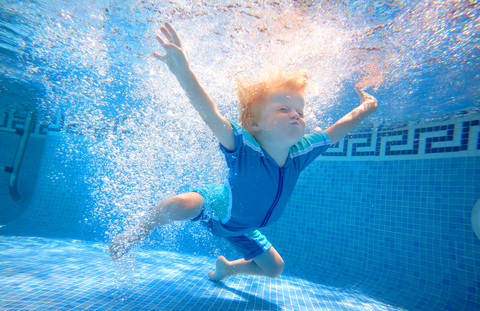
The next time I went to the pool I walked straight to the deep end and jumped in. it was such a joyful and even slightly surprising experience. The feeling of falling through the water and then being gently caught and sent back up towards the surface. I often ask the children I teach to feel for the sensation of tiny bubbles bursting on their bodies as they jump in but I was too overwhelmed by the unusual for me sensation of jumping into the water to do this.

As I came to the surface I found myself laughing. I understand now why the children in my lessons want to jump in all the time and I wondered why I had left it so long.

When my friend arrived we jumped in together. We didn’t hold hands but next time we might.

“Water is the commonest symbol for the unconscious” – Carl Jung

Water-802215“Water is the commonest symbol for the unconscious. The lake in the valley is the unconscious, which lies, as it were, underneath consciousness, so that it is often referred to as the ‘subconscious,’ usually with the pejorative connotation of an inferior consciousness. Water is the ‘valley spirit,’ the water dragon of Tao, whose nature resembles water- a yang in the yin, therefore, water means spirit that has become unconscious.” (Carl Jung, CW 9i, para 40)

“We never stop telling the students how to do things.” Richard Feynman

FeynmanOne problem I have in my children’s swimming classes is that I always feel the parents want me to tell the children how to swim. They want me to tell them exactly what to do with their arms and legs. The children usually want to please so if you tell them to do something they will try to do it. But this means that they stop feeling the water, stop being aware of their own bodies moving through the water and the result is often that their swimming becomes laboured and uncomfortable. If you allow them to play and find their own movements, then just gently show them what to do the swimming is much more graceful. This is even more true of non-swimming adults. I have to get them to feel the water, to work out a little bit for themselves how to move their bodies through the water and then help them to refine the movements. Good swimming is all about feeling relaxed and confident in the water. This only comes with experiment, play and practice.

Here is Nobel prize winning physicist Richard Feynman talking about the difference in the way art and science are taught. He was learning to draw.

“I noticed that the teacher didn’t tell people much (the only thing he told me was my picture was too small on the page). Instead, he tried to inspire us to experiment with new approaches. I thought of how we teach physics: We have so many techniques—so many mathematical methods—that we never stop telling the students how to do things. On the other hand, the drawing teacher is afraid to tell you anything. If your lines are very heavy, the teacher can’t say, “Your lines are too heavy.” because some artist has figured out a way of making great pictures using heavy lines. The teacher doesn’t want to push you in some particular direction. So the drawing teacher has this problem of communicating how to draw by osmosis and not by instruction, while the physics teacher has the problem of always teaching techniques, rather than the spirit, of how to go about solving physical problems.”

Especially when teaching adults who have spent a whole life not learning to swim and may be very fearful, it is important to teach the spirit rather than just the technique of swimming.

Where does water come from?

dreamstime_xs_1974167One of the children in my swimming class asked me this today. I had to think for a bit then I kind of remembered reading something about water being created as stars formed billions of years ago and I said water had been here about as long as the Earth has been here, hoping I was right. Then I talked vaguely about rain and clouds, ice and steam and how water can change from one thing to another but it doesn’t disappear and you can’t make it.

As we were off on this scientific, philosophical tack another little girl asked me why the water was blue, was it reflecting the sky. Then she thought for a bit and said

‘What colour is water ?’

I said it didn’t really have a colour but it looked blue because it was reflecting part of the light. Again I was sort of hoping I was right.

I knew my knowledge on both subjects was not really sufficient to explain things in a way they would understand. I had to just give them the words and let them see what they could make of it.  Some of them weren’t really listening anyway, they were too busy practising somersaults and handstands under the water, but the ones who were seemed satisfied.

Sometimes swimming lessons can be quite deep.

The secret to learning anything

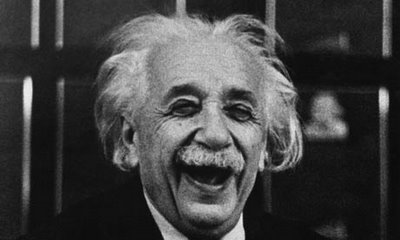
einstein-laughingSometimes parents say to me that they are worried that all the children are doing in my lessons is playing. I am not sure that these parents always appreciate that, especially in the water, it is through playing that the children learn. When I teach non-swimming adults the main difference between them and the children is that they don’t play in the water. It is true that sometimes the children can enjoy the lessons so much that things get very lively. Then I have to remind them of two basic rules

  • don’t jump in without asking me
  • don’t hold onto each other in the water.

These have to do with safety and are not too difficult to remember, although we do have to over them quite often. I believe that to learn any new skill properly, at any age, you have to enjoy the process. Here is a letter from Albert Einstein to his eleven year old son. It was written in 1915.

“I am very pleased that you find joy with the piano. This and carpentry are in my opinion for your age the best pursuits, better even than school. Because those are things which fit a young person such as you very well. Mainly play the things on the piano which please you, even if the teacher does not assign those. That is the way to learn the most, that when you are doing something with such enjoyment that you don’t notice that the time passes. I am sometimes so wrapped up in my work that I forget about the noon meal. . . .”

He wrote this letter just after having completed his General Theory of Relativity.

My thanks to Maria Popova for drawing my attention to this quote in her blog

www.brainpickings.org

Fear of falling

Photo by Mark Tipple

Photo by Mark Tipple

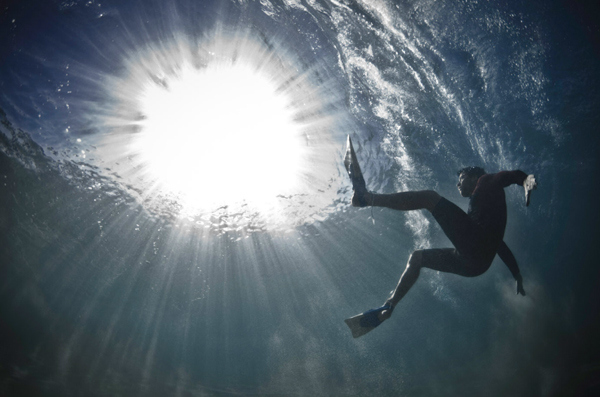
One of my pupils told me that the reason she found it difficult to learn to swim was that she had a fear of gaps. She said she did not like stepping from the platform to the train, or even crossing bridges and that being in water made her feel the same way.  She told me she could float and was not afraid to put her face in the water but it was the moment of taking her feet off the bottom of the pool that scared her.  She said that the moment of launching herself into the water is like the moment when you are falling asleep and you feel yourself fall off the edge of something, the moment when you suddenly jerk back to wakefulness. One man told me that his father had dangled him over a bridge when he was a child and he had been afraid of water ever since. He is learning to swim now, fifty years later, and doing well.

I think for many people fear of water is like a fear of falling, of being unsupported and many  people are able to swim as long as they are touching me. Even if I just touch them lightly with the finger of one hand they can swim, but as soon as I move my hand they panic.  One lady could swim if we swam together, with both of us swimming and me holding her hand, but even though I was not supporting her at all, she could not swim if I let go of her.  And many people can swim if I help them to start off, if I manage to get them over the falling moment when the ground disappears from under their feet.

All this has shown me how deeply psychological the fear of water and fear of swimming can be. It is therefore not surprising that once people start to overcome their fear of water, they sometimes find that other fears become less too; like the man who told me that once he had stopped being afraid of the water he also found that he had stopped being afraid of dogs.

It is interesting to watch people lose their fear. It doesn’t happen immediately of course but as long as the person keeps coming to the lessons the fear always goes, it just sort of floats away. I believe this is because the fear sits in a very deep and instinctual part of the memory or experience and is not really connected to the present situation. In a heated swimming pool, where they are never out of their depth and where I am there to help and support them, most people learn to swim.

Watching people overcome this fear has got me thinking about the nature of fear itself and how many of us are limited by fears that are not based in reality.

Tumblers

?????????????????????????????????????????????????????????????????????????????????Every now and then, in my children’s swimming classes I get a tumbler. By this I mean a child who seems to so delight in the freedom and weightlessness of being in the water that they just tumble about, twisting and turning, looping the loop and turning somersaults. These children do not mind at all being right under the water, and they do not mind that where I teach they can’t put their feet on the bottom. They seem to trust me to catch them in time for them to take a breath every now and again. Sometimes they hold their noses, sometimes they have goggles, but sometimes they seem to manage without either. Eventually, having fully explored the watery environment, and if you don’t bother them too much, they straighten out and start to swim along in a more conventional fashion.

Breathing

One of my pupils never learned to swim as a child because she grew up in a war zone. Now in middle age, she needs to learn because health issues make other forms of exercise difficult. She told me that her abiding memory of childhood is of running from the shelling and even now she has nightmares almost every night. She said to me

‘Now we are talking about sending people to the moon as tourists! Surely we can find some other way than violence to resolve our conflicts here on Earth.’

Her swimming is coming on well. She is concentrating on the breathing which is always the most difficult thing to learn.

Success

I was witness to two great successes today. One of my pupils told me that after only four lessons of front crawl (she had never swum the stroke before) she completed the swimming section of a triathlon. It was seven hundred and fifty metres, in open water; she did it in twenty five minutes, which is not bad at all.  Another of my pupils who was a non swimmer, and did not like to put his face in the water, today, in his fourth lesson, swam a length of the pool.

Today was a good day.

Some of them were dreamers…

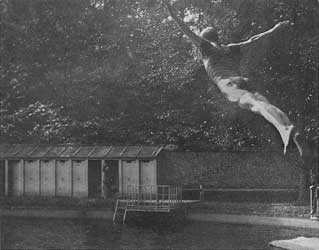
This photo is by Jean Martin Lartigue - a wonderful photographer, who was 'discovered' at the age of 69, although he had been painting and taking photographs all his life.

This photo taken in 1910 is by Jaques-Henri Lartigue – a wonderful photographer, who was ‘discovered’ at the age of 69, although he had been painting and taking photographs all his life.

One of my first ever swimming pupils was a friend. He had never learned to swim as a child mainly because his childhood had been disrupted and he had moved around a lot and maybe no one had ever taken him. I didn’t really teach him much, just went swimming with him during one very hot summer. We went to the local pool which was a beautiful open-air Lido, now demolished. It had a sweeping Art Deco staircase leading to the changing rooms, two fountains and pink paving stones surrounding the pool. It was beside the Thames just opposite Eel Pie Island. There was and is a footbridge over to the Island. The bridge is arc shaped, like a concrete rainbow with metal railings on each side. Once after we had been swimming we were sitting down by the river when we saw a man  walk up to the top of the bridge, climb over the railings and execute a beautiful swallow dive into the Thames