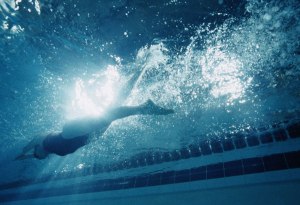
Fear of flying

?????????????????????????????????????????????????????????????????????????????I have worked with many non swimmers who tell me they are afraid of putting their faces in the water.  Although it is a common fear, putting your face in the water is easy and almost everyone can do it without a problem more or less straight away. I have never, ever had anyone finish a lesson without being able, quite happily, to put their face in the water. I tell them to hum a nice song. That way their mouth is closed and the air comes out of the nose, and they are also a bit distracted. They may be afraid of seeming foolish but in the water no one can hear you anyway.

A much more persistent fear, and one that is much more difficult to let go of, is the fear of floating. It is not usually an inability to float that is the problem, that is only very, very rarely the case; rather it is the fear of being ‘untethered’ and free. We are so used to holding on in life, that to let go and float is very difficult for some people.

One woman said that it felt like the moment when you are falling asleep and you suddenly catch yourself and wake yourself up with a start. This made a lot of sense to me. Similarly in the water, you are letting go and allowing yourself to float freely and for a non swimmer this can be an unfamiliar and frightening experience, and it can feel like falling if you don’t realise that the water is there to catch you. Not everyone can overcome this fear quickly. For some people it can take a long time to let go and trust the water. This is true for children as well as adults. Sometimes people are OK as long as they have something to hold on to. One pupil could swim as long as she was holding my hand, another one was fine as long as she could touch me with one finger. But as soon as I took my hand away, even though I was not supporting her at all, she got that falling feeling and was snatched by a panicky fear .

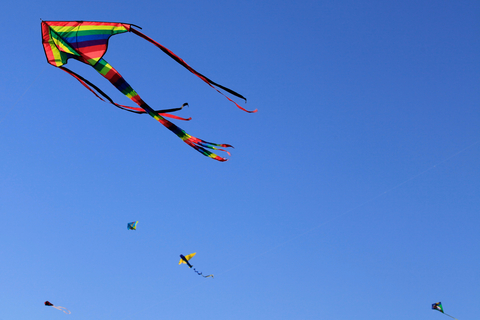
A woman I was teaching last week  who had been rather quiet until then told me she had just come back from a Kite festival in France. It sounded so beautiful watching all the colourful kites flying high up in the sky. I told her that swimming is the closest you can come to flying in scientific terms, and it is.

Planet Earth is blue

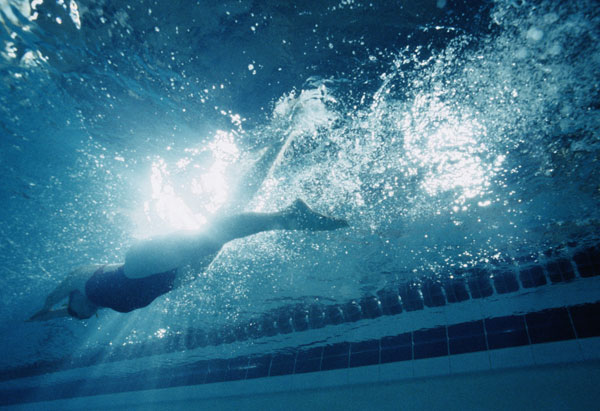
Photo by Mark Tipple used here with kind permission.

Photo by Mark Tipple used here with kind permission.

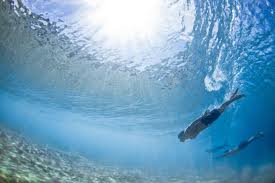
Anyone who has been surfing or just been swimming in big breaking waves, will know the feeling of sometimes misjudging it and being tumbled over and over in the water, not knowing which way is up or down. We tend to close our eyes at these moments, but Mark Tipple kept his open and started taking  photographs of surfers under the waves. Here is a link to his website where you can see more of his beautiful photographs.

Mark Tipple’s website

Riff Raff the swimming dog

riff raffMany dogs of my acquaintance love to swim. They seem to understand the pure joy of being in the water. Unlike humans, dogs, and most mammals it seems, don’t need to learn to swim. They can just do it, in fact most dogs are better swimmers than humans. Their heads are above water, their fur keeps them warm, many have waterproof undercoats, they have a low centre of gravity, their lungs have a higher capacity than most human’s and some breeds even have webbed feet.

The beautiful, kind and radiant, Riff Raff, who sadly died yesterday was an exuberant and enthusiastic swimmer. Watching her leaping into the water reminded you what joyfulness, hope and optimism was.

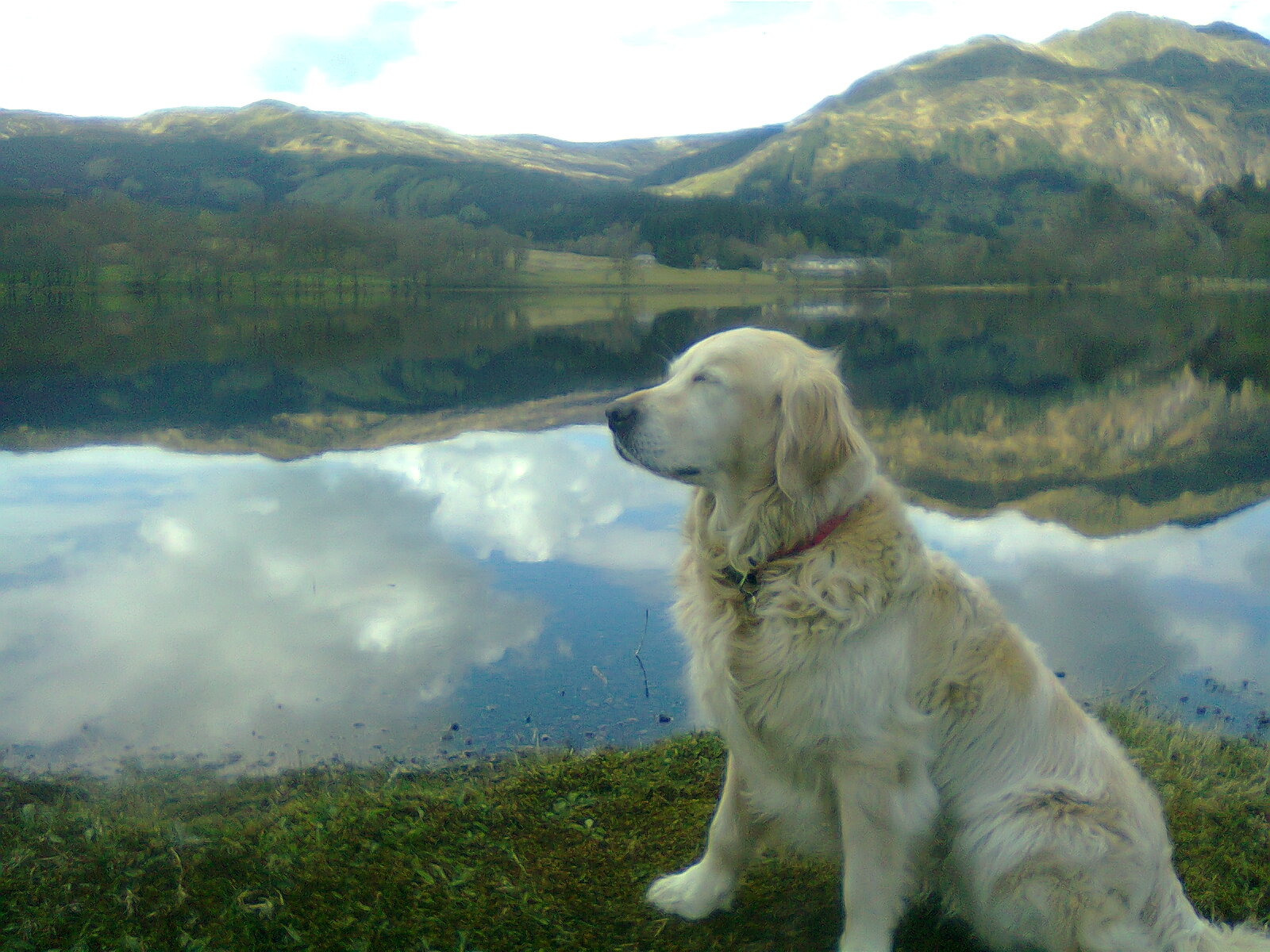
I mostly saw her swimming in the Thames but here she is on one of her Scottish holidays, deep in canine meditation, immediately pre-dip.

‘The water always tells me a new story’ – Annette Kellermann 1918

‘I have been asked a thousand times why I like to swim and I have given a different answer every time. You see the water always tells me a new story.’

‘Swimming cultivates imagination; the man with the most is he who can swim his solitary course night or day and forget a black Earth full of people who push.’

Annette Kellermann 1918

Sea horses

Sea HorseOne of the most remarkable experiences of my life took place on Cape Tribulation in the far north of Australia. It was summer time and very, very, hot and very, very, humid. My sister and I were staying at a hostel in the tropical rain forest, next to a mangrove swamp and the sea. There was a generator for power which was switched off at ten o’clock at night. After that unless you had candles or a torch, which we didn’t, the night was completely black and dark but far from silent, as the rain forest outside (and inside) the huts, was teaming with life.

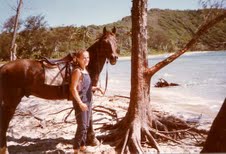
We were staying for a few days and my sister had noticed that there was a riding stable next to the beach.  That sister, like all my sisters,  is a a very keen and very good horse rider, so we decided to see if we could go riding. She arranged for us to arrive early to help get the horses ready with bridles and saddles. Although I do know how to ride I  hardly knew what to do to prepare the horses; my sister was expert. She has a special affinity with and love for horses and is truly happy around them. There were about five or six of us going for a ride that day and the setting was beautiful. The tropical environment may be beautiful but it is harsh and we had been told that at that time of year you could not swim in the sea because of the blooms of deadly box jelly fish.

We set off along the shore line at a gentle walking pace, in the shade of the trees, but towards the end of the ride the horses broke into a gallop. I was a little bit fritghtened but  I hung on tight, my sister flying along in front of me. It was thrilling and exhilerating. Galloping along that tropical beach would have been enough of an experience to last me my whole life, but when the ride was over the leader said to us.

Would you like to take the horses for a swim?

At first I was worried about the deadly jelly fish, but the leader said that as we were wearing our jeans our legs were covered so it would be alright.

She asked us to take the saddles off the horses as the salty sea water would be bad for them. We left the reins and bridles on.

So now we were riding bare back which I had hardly ever done before and I began to feel more at one with the horse.

Following our leader, we steered the horses towards the water. They were hot and sweating after the gallop and the water must have seemed inviting to them. They stepped delicately into the waves. This part of the coast was within the great barrier reef, so there was very little breaking surf and the water was calm.

The water quickly covered our feet and legs and was soon up to our waists. Then I realised my horse’s feet were no long on the ground and she was swimming straight out to sea. We were laughing and excited but then above the sounds of human voices I started to hear another sound. It was a strange, moaning, groaning sound. It was coming from the horses. They were stretching their heads up out of the water and the noises they were making were completely unlike any sound I had ever heard a horse make before. It was not any kind of snorting or, neighing or winnying, rather it was a kind of ectstatic bellowing. It seemed that the horses were relieved to be in the cool water. I still don’t really know if that is what it was. The leader of the group said that they always did that in the sea.

Many years later I asked a vet who mainly treated race horses if he had ever heard of such a thing, and he said that yes under those kind of circumstances horses do make that kind of noise, but he was a bit vague.

At the time I felt a kind of wonder, mixed with just a touch of fear. At one point the horses were heading out to sea and I wasn’t sure how I was going to get mine to turn round. But she did of course, following the others and soon I could feel the solid ground under her feet. As we emerged from the water, the horses stopped groaning. We rode them back up the beach, put the saddles on and took them back to the stables. In all we had probably been out for an hour or so, but it is an experience that will stay with me forever.

Not waving

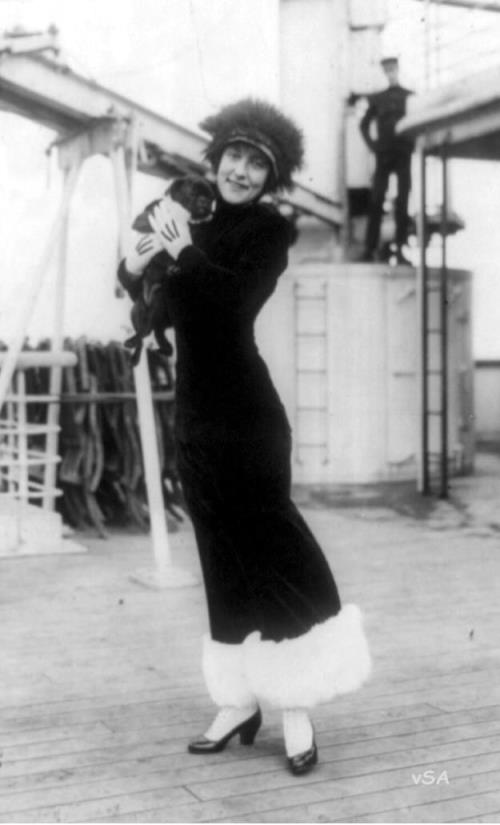
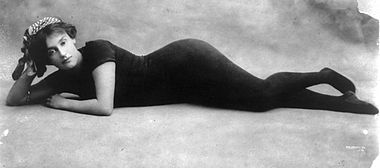
Annette Kellermann Annette Kellerman was the first woman to attempt to swim the channel. She also invented the one piece bathing costume for women (the wearing of which she was arrested for on the beach in 1908 in Massachusetts; although the case was dismissed because Kellermann argued that cumbersome costumes prevented women from learning to swim).

She published a book ‘How to swim’ in 1918.

To master the art of swimming is a duty which you owe not only to yourself but to others. By being able to swim, you lessen the chance of losing your own life, and also cease to become a source of danger to others in case of accident. Now if you will add to your swimming the accomplishment of life saving, you will become a positive element of safety to others.

and

The best thing that a non-swimmer can do to decrease his risk of drowning in case the boat upsets is learn to swim. Having neglected this precaution, the next best thing will be to have the presence of mind not to lose his sanity while he is drowning.

She goes on to qualify this last remark by explaining that

The non-swimmer is usually drowned by his own efforts. What he should do is remain perfectly quiet and float.

However

This advice to the drowning man is good advice; the only drawback is that when one is drowning one is not in the mood to appreciate its value.

‘How to swim’

Annette Kellermann - How to swim 1918

Annette Kellermann

‘Though it seems paradoxical, one must have absolute abandon and at the same time minute precision, to become a good swimmer.’

How to Swim – Annette Kellermann 1918

Diving for pearls – the women free divers of Japan

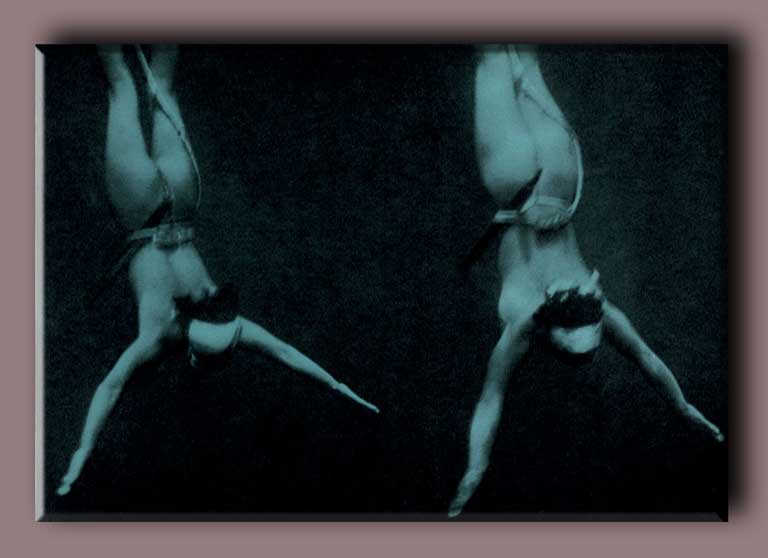
photo by Yoshiyuki Iwase

photo by Yoshiyuki Iwase

In fact the ama-san or women free divers of Japan are not diving for pearls as was once thought but for abalone, namako (sea cucumber) and oysters. Some estimate that the practice is as much as two thousand years old. The ama, who are all women, dive without scuba equipment such as oxygen tanks although today they do wear wet suits. It was the women who did the diving because they were able to stay under water in the cold for longer than the men. Ama divers today are mostly older; many are in their fifties or sixties, some keep on diving into their eighties and nineties. Younger women tend to leave the remote island communities where the Ama live and travel to the cities.

These women are pursuing a traditional, deliberately sustainable and ecologically sensitive tradition. The men help the women with the nets, the boats and keeping house.

This beautiful video tells their story. The title comes from the strange whistling noise the women make before diving. This helps them to stay under water for longer.

Where the sea whistle echoes

‘In the water I am free’ – Swimming and rheumatoid arthritis

Bus to the pool

Bus to the pool

woman swimmingI have a good friend who is a keen swimmer and also suffers from rheumatoid arthritis. Rheumatoid Arthritis (RA) is an autoimmune disease. This means that the body reacts to some of its own cells as is they were foreign and so attacks them as it would a virus or bacteria. RA can affect many tissues and organs but it mainly attacks flexible (synovial) joints. It can be very painful and disabling and it can lead to loss of mobility and loss of function. It is not the same as osteoarthritis which tends to affect people as they get older, however both osteo and rheumatoid arthritis cause inflammation of the joints.  This can result in pain, stiffness, swelling, a decreased range of motion and fatigue. Swimming is an excellent exercise for arthritis sufferers because it provides an aerobic workout without putting strain on the joints.

There are treatments for RA but at the moment there is no cure. Scientists do not know exactly what causes it. There may be a slight genetic predisposition to getting the disease and there are a few factors that can slightly increase the risk but on the whole the onset seems fairly random.

My friend is a very active and lively person, she was fit and healthy, always out walking or riding her bike and the last person you might expect to be hit by such a disease.

We have become good friends partly through our mutual love of swimming, she swims every day, and I decided to ask her about what swimming means to her and how it has helped her deal with the RA.

I’ve always been a keen swimmer. When I was a child I had a book called ‘My Little House’. It was about a lovely house in the country and there were some children living in the house who used to swim in the river nearby, or skate on the pond in the winter. Then gradually the house became hidden under a mass of buildings and roadways and flyovers until eventually it was completely hemmed in. So they decided to move the house on the back of a truck, it was an American book, and they took it to a perfect place in the country, but I remember thinking ‘but there’s no river, no stream, no pond’. I thought ‘where is the water?’. And I’ve always had that sense that to be happy you need to be near the water.

When I was diagnosed with rheumatoid, swimming was my salvation. I said to the doctor, for whom I have a great deal of respect, ‘Will I still be able to swim properly? Will I still be able to swim a mile?’ and he said ‘We just don’t know’. But I can, I swim about a mile most days. It takes me forty minutes.

Swimming is my mental and physical escape. It is not just about the exercise, although that is important, it is cleansing and relaxing too in the deepest sense. I always go to the same pool, the local one, that I fought very hard to save from closure, before I was ill, before I knew I would need it so desperately.

The council was allowing the pool to fall in to disrepair, they wanted to sell off the land, and we had to fight long and hard to keep it open. I spent eight years campaigning against its closure and for re-investment and refurbishment and we won in the end. I am still on the safeguarding committee. We had the indoor, outdoor and learning pool re-tiled and I had to fight hard to keep the depth of the pool, it is three metres deep in some places and it would obviously been cheaper to make it a bit shallower, but I really wanted to keep the depth.

In the end I think we won the fight against closure because I managed to convince a local councillor who subsequently became the local MP and who was also a doctor, that we had to have a children’s teaching pool in the borough, that our children had to have somewhere they could learn to swim.

I go to the pool almost every day. It is crucial to me and so I fit my work around it. It is a beautiful light, long airy pool with big windows to the ground,  on three sides and an outdoor pool that is open in the summer. It is a public pool and I prefer that to exclusive private clubs. I meet like-minded people there, other swimmers, but they are from all walks of life, all ages, varying degrees of fitness. As I have said the pool has a proper deep end, also it is nice and long, thirty-three metres. I am afraid I am a bit lengthist when it comes to swimming pools.

My condition means that I can’t do much walking and no cycling, which I used to love, so the swimming is a very important exercise for me. It keeps the muscle tone, and exercises the joints, it also helps me to stretch. I have to be careful not to overdo it. My favourite stroke is front crawl but I have to limit the amount I do. I can swim on my back if I don’t push myself too hard but unfortunately breaststroke is out for me these days apart from in the sea.

There was no bus running to the pool and although I do have a car I felt that it was important that people should be able to get to the pool by bus, especially children, and I am pleased to say that after eight years of my campaigning we now also have a bus that goes directly to the pool.

I have watched children with all sorts of disabilities being taken swimming and you can see how they relax in the water. The carers and teachers have told me that the children are calmer and happier after they have been in the water.

My condition has limited my mobility in many ways but I am equal in the water, and I am free.’

Swimming, mindfulness and the Eureka moment

The story goes that Archimedes was in the bath when he shouted Eureka (I have found (it)). He realised that the volume of water he displaced getting in to the bath must be equal to the volume of the part of his body that was submerged. So, after long reflection, he had  discovered a way that the volume of irregular objects could be measured with precision. I have read that he was so delighted that he got out of the bath and rushed through the streets of Syracuse naked.

Most people recognise the phenomenon of a sudden flash of insight, the solution to a problem that you may have spent days, weeks, months or even years puzzling over.

Daniel Goleman’s book The Brain and Emotional Intelligence: New Insights is beginning to reveal what goes on in that Aha momeeurekant.

Here is Goleman in his own words.

Brain studies on creativity reveal what goes on at that “Aha!” moment when we get a sudden insight. If you measure EEG brain waves during a creative moment, it turns out there is very high gamma activity that spikes 300 milliseconds before the answer comes to us. Gamma activity indicates the binding together of neurons, as far-flung brain cells connect in a new neural network – as when a new association emerges. Immediately after that gamma spike, the new idea enters our consciousness.

This heightened activity focuses on the temporal area, a center on the side of the right neocortex. This is the same brain area that interprets metaphor and “gets” jokes. It understands the language of the unconscious what Freud called the “primary process”: the language of poems, of art, of myth. It’s the logic of dreams where anything goes and the impossible is possible.

That high gamma spike signals that the brain has a new insight. At that moment, right hemisphere cells are using these longer branches and connections to other parts of the brain. They’ve collected more information and put it together in a novel organization.

What’s the best way to mobilize this brain ability?  It’s first to concentrate intently on the goal or problem, and then relax into stage three: let go. The converse of letting go – trying to force an insight – can inadvertently stifle creative breakthrough. If you’re thinking and thinking about it, you may just be getting tenser and not coming up with fresh ways of seeing things, let alone a truly creative insight.

So to get to the next stage, you just let go. Unlike the intense focus of grappling with a problem head-on, the third stage is characterized by a high alpha rhythm, which signals mental relaxation, a state of openness, of daydreaming and drifting, where we’re more receptive to new ideas. This sets the stage for the novel connections that occur during the gamma spike.

Those moments of out-of-the-blue, spontaneous creative insights may seem to come out of nowhere. But we can assume that the same process has gone on, where there was some degree of engagement in a creative problem, and then during “down time” neural circuits make novel associations and connections. Even when creative insights seem to arise on their own, the brain may be going through the same moves as during the three classical stages.

On the other hand, I would guess that the three or four classical stages of creativity are somewhat of a useful fiction – the creative spirit is more freewheeling than that. I think the main neural action is between intense focus on the problem and then relaxing about it. And when that creative idea arrives, it’s almost certain that the brain has gone through that same heightened pitch of gamma activity that was found in the lab.

Is there a way to create the conditions whereby the gamma spike is more likely to occur? Gamma spikes normally come at random – they can’t be forced. But the mental stage can be set. The pre-work for the gamma spike includes defining the problem, then immersing yourself in it. And then you let it all go – and it’s during the let-go period that gamma spike is most likely to arise, along with that “Aha!” moment, the light bulb over the head of a cartoon figure.

There’s a physical marker we sometimes feel during a gamma spike: pleasure. With the “Aha!” comes joy. Then there’s that fourth stage, implementation, where a good idea will either sink or swim. I remember talking to the director of a huge research lab. He had about 4,000 scientists and engineers working for him. He told me, “We have a rule about a creative insight: if somebody offers a novel idea, instead of the next person who speaks shooting it down – which happens all too often in organizational life – the next person who speaks must be an ‘angel’s advocate,’ someone who says, ‘that’s a good idea and here’s why.’”

Creative ideas are like a fragile bud – they’ve got to be nurtured so they can blossom.

Daniel Goleman

As a swimmer I have for a long time counselled friends and family, and myself, to take their problems to the water. I have said before that swimming helps with all troubles. I had no real explanation for this but perhaps science is now beginning to show that if you can induce a state of mindful meditation, you can free your brain to do its own work, undisturbed by conscious, controlling thoughts. I also believe that being submerged in water adds something extra. I think it was more than a happy accident that Archimdedes was in the bath when he made his discovery.