The dive reflex

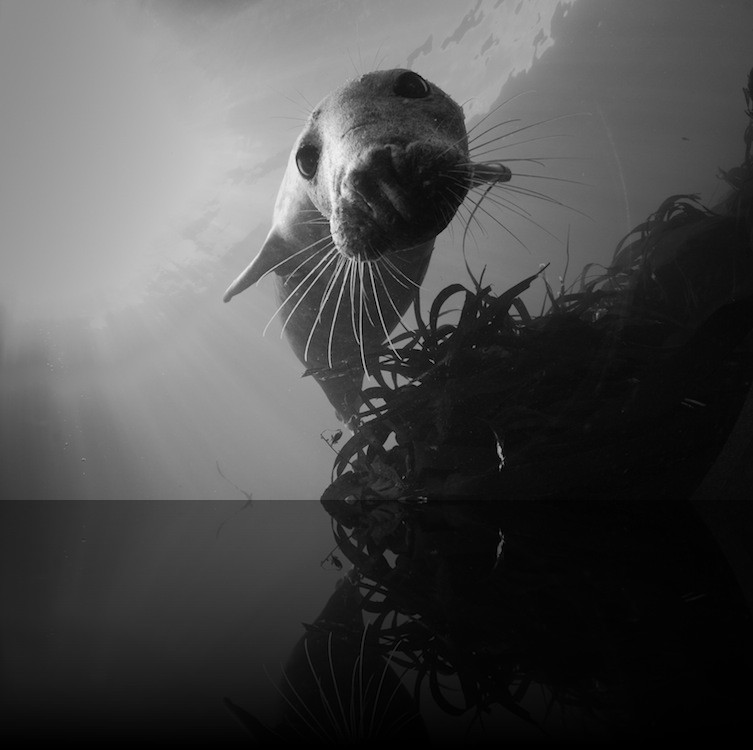
Diving seal, Farne Islands, photo by Farne Island Divers

Diving seal, Farne Islands, photo by Farne Island Divers

All mammals, including humans, have a diving response. This consists of three physiological changes in the body:

  • The heart rate slows down, by about 10% – 30% sometimes more (with training).
  • the blood vessels narrow causing reduced blood flow to the limbs
  • on deep dives a blood shift takes place allowing plasma and water to pass into the chest cavity to ensure that the pressure stays constant and the organs are not crushed.

These changes allow the body to tolerate a low level of oxygen. It is the diving response that allows otters, seals and other water mammals to stay under water for a long time. The effect is much less pronounced in humans but it exists. The slowing of the heart rate happens very quickly if you put your face (mouth and nose) into water that is colder than about 21 degrees C. The colder the water the quicker the response.

Photo courtesy of Farne Island Divers

Swimming for happiness

I have noticed that whenever I am feeling low going for a long swim lifts my mood. It has helped me through some fairly prolonged troubled patches in my life.  I found that no matter how bad I was feeling, if I went for a swim, my mood would lift significantly about 2 to 3 hours after I had left the pool. The effect was clear and predictable. I always felt better, at least for a time. The effect would then last for 3 to 4 hours.

I believe that part of this is the effect of excercise on the brain, and would have perhaps been the same if I had gone for a run, but it seems to me that there is something extra that swimming does to the body.

I looked to see if I could find some research on the effect of swimming on mood, but although it may exist I couldn’t find any. All I have to go on is my own experience.

I have a regular weekly appointment to go swimming with a good friend of mine who suffers from a chronic physical condition, rheumatoid arthritis. She swims every day partly because it is the only form of excercise she can realistically do, and partly as a way of coping with the challenges of her illness. I always meet her, every week, for a long swim, no matter what else is going on in my life. There have been some bad times when it has seemed like the only thing I could rely on. We usually go to the local pool. There is an outdoor pool that is open from May to September so five months of the year we swim outside. We always have a coffee and a chat afterwards and that can be very therapeutic in itself as my friend is very calm and kind and wise, but I am sure there is something in the swim itself that is so helpful and healing.

Besides possible biochemical changes in the brain, swimming requires the alternating stretch and relaxation of skeletal muscles while simultaneously deep-breathing in a rhythmic pattern. These are key elements of many practices, from hatha yoga to progressive muscle relaxation, used to evoke the relaxation response. Because it is so rhythmic swimming lends itself easily to a meditation. As I am always trying to work on the smoothness and efficiency of my stroke I am very aware of my whole body and how I am using it. I often chant or even sing to myself as I am swimming.

Again I have nothing to prove it but I am sure that swimming strengthens the immune system. I swim at least one kilometre a week and have done regularly for the last six or seven years. I swim mainly front crawl and I swim quite strongly. Although I do very occasionally get colds, I find that they are over very quickly, just as they were when I was pregnant. The cold would come and go very quickly instead of dragging on for days or even weeks which was sometimes my experience before I started swimming so much.

Mindful swimming

I have called this blog mindful swimming without really explaining what I mean. There are hundreds, even thousands of books, website, blogs, courses, research papers etc on mindfulness, but nothing I can find on mindful swimming. However, lots and lots of the books, pages etc have pictures, drawings, representations of water. Water and mindfulness it seems, go together. To me swimming is an inherently mindful activity.

Swimming is a solitary activity. Although you may be in the pool, lake, river or sea with many others, essentially you are alone when you swim. You are alone with your thoughts and feelings. Your body is as near to weightless as it is possible to experience. You need to concentrate on coordinating your breathing so you need to be aware of the breath entering and leaving your lungs. Swimming is a very rhythmic activity. Swimming lengths in a pool can be an ideal time to meditate.

The children that I teach show me how to be mindful without even realising it. One little boy said to me after he had jumped in that he could feel the water fizzing. He was talking about the air bubbles bursting against his skin. I had never noticed that even though I have jumped and dived into water thousands and thousands of times. Maybe I did notice when I was a child but I had forgotten to feel it. For this little boy it was a new sensation and so he noticed it.

Combative swimming

I know we used to have to swim in our pyjamas when we were at school doing life savers’ badges but this is taking things a step further.

BBC item about Samurai swimming in Japan

Matt Caines Sculptor

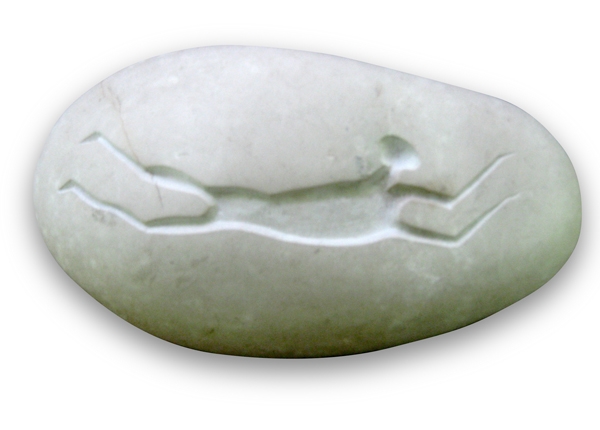
When I was researching the post on The Cave of Swimmers I came across a picture of this sculpture that uses the representation of a swimmer taken from the neolithic paintings in the cave at Wadi Sura in Egypt.

Cave of Swimmers - marble - sculptor Matt Caines

Cave of Swimmers – marble – sculptor Matt Caines

I love this piece. Here is a link to the work of the sculptor, Matt Caines, who made it.

Matt Caines Sculptor

‘My legs are dancing!’

This was from a little boy of about four or five that I was teaching. His Mum is Irish and though he himself doesn’t have an Irish accent he has a kind of Irish inflexion sometimes in the way he speaks. He was nervous of the water and at first didn’t want me to let go of him even though he was using a noodle, a long tube of foam that we use as a buoyancy aid.

But then I think he suddenly felt the sense of weightlessness and freedom of his legs dancing in the water beneath him as he realised that neither the noodle nor the water were going to drop him.

One thing that all new swimmers have to learn is the unusual sensation of the small amount of resistance that the water offers to their limbs. It is more than air, about twelve times as much in fact, but not as much as a solid object. But it is not no resistance at all, it is just a little bit and to swim you have to learn to recognise and use this. It is this that is easier for children than adults. Most adults and children use jerky sudden movements in the water until they have learned the soft fluid, yet strong movements that are needed to propel yourself through the water.

I have learned not to say too much about what exactly one needs to do with the arms and legs as I find, especially with the children, too much instruction can interfere with the learning process. I prefer to let them find their own way then offer a little bit of direction. Some children are incredibly inventive and come up with ideas of their own. It is fascinating to try to understand the way they experience the water. One little boy said to me very seriously

‘The water never stops moving, even at night. ‘

Another one asked me

‘Why are there mountains in the water?’

I was confused at first until he showed me what he was looking at. There were quite a few people in the pool so the surface of the water was rippled and waved. From down at his level close to the surface of the water the waves looked just like a mountain range.

(This little boy also thinks my name is Dave, which is fine.)

The cave of swimmers

It seems that one of the earliest references to swimming is in these Neolithic cave paintings in Egypt. These paintings are about 10,000 years old. The swimmers are the little figures by at the bottom of this photo, by the feet of the taller figure.

The Cave of Swimmers is situated at Wadi Sura on the Gilf Kebir in south west Egypt, near the Libyan border.

Cave paintings including swimmers at Wadi Sura

‘My experience as a new swimmer’

It seems that sometimes dealing with one fear can affect others. One of my students told me that when his fear of the water left him, so did his fear of dogs. I asked him to write something about this. This is the lovely message he sent me, reproduced here with his permission.

Dear Jane

Thank you for teaching me how to overcome my fear of water and learn how to swim the proper way. You have given me a lot of confidence and you are a fantastic and patient teacher. By learning to swim it has also helped me in many other ways, for example I have self confidence and have over come the fear of dogs too. Again I thank you very much you are absolutely wonderful and I wish you well and will send all my customers to you who want to learn how to swim,

Kind regards

Cyrus Abraham

Shaw Method

I trained with Steven Shaw at Art of Swimming as a Shaw Method teacher at the same time as I was studying for my Amateur Swimming Association level two qualification. Shaw Method is a gentle approach to swimming without strain or stress. It is based on the Alexander Technique

This is what Steven Shaw’s company The Art of Swimming says about the Shaw Method.

Shaw Method applies the principles of  Alexander Technique to swimming. Alexander Technique will teach you to use your body and mind without strain. Put simply, this is what Shaw Method also seeks to achieve, in the water.

Shaw Method teaches greater body awareness, strengthens the relationship between mind and body, promotes freedom of movement, and helps to prevent strain and injury.

I loved the training it was innovative and inspirational. It transformed my own swimming and now when I am swimming in the people often comment on the smoothness and ease of my stroke. I also learned to swim butterfly for the first time in my life. I discovered that using the Shaw Method approach butterfly can be a smooth elegant relaxing stroke.