
Front crawl

One of the most common requests I get is from people who can swim but can’t swim front crawl, or think they can’t. In fact front crawl is an easy, relaxing and calming stroke if done proplerly. I often see people, I am afraid to say, especially men, swimming a wild thrashing kind of front crawl. They are using a lot of energy, making a lot of splash, but not travelling very fast. Or they may be able to travel fast for a short while and then collapse exhausted at the end of a length. This is inefficient and unnecessary.

As with all swimming strokes the key is to let the water do most of the work. First of all you must find a good balance in the water. A gentle leg kick is all you need. In fact it is perfectly possible to swim a reasonable front crawl without kicking your legs at all. You should kick from the hips, not the knees and the kick should be gentle, a flutter rather than a big scissor kick.

Look straight down at floor of the pool, keep your neck long.

As you reach forward with each stroke let your body rotate keeping the head still.

Feel the glide on each stroke, listen to the water.

Roll out to breathe, letting your head turn to the side. Don’t lift the head. Imagine you are breathing from your core. Get the feeling of turning your lungs to the air, not your head.

Try to make sure your left arm stays on the left side of your body, and the right arm stays on the right side. Don’t let your arms cross over in front of you.

Breathe out gently under the water so that you are ready to breathe in as you turn.

Keep the stroke slow, steady and relaxed. As your stroke becomes more efficient you will get faster.

Feel the rhythm of the stroke. Sing to yourself if it helps.
Watch this beautiful stroke.

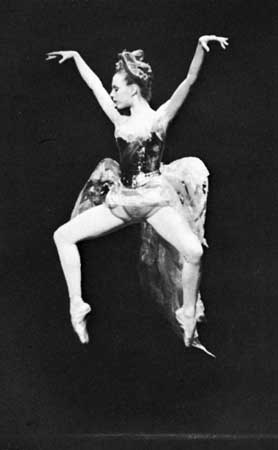
Swimming and ballet. Transferable skills?

2nd position en pointe, executed by Gelsey Kirkland, in the Firebird. Image from Britanica Online Encyclopedia. Credit Martha Swope

2nd position en pointe, executed by Gelsey Kirkland, in the Firebird. Image from Britanica Online Encyclopedia. Credit Martha Swope

These are two of my passions and I am fascinated by the parallels and similarities between them. Olympic swimming champion Liam Tancock, believes that the poise ballet gives you is important for a swimmer as are the core strength and strong ankles that ballet dancers need.  He took weekly ballet lessons of part of his swimming  training.

In a TV interview he also pointed out that ballet dancers must place their limbs and their hands and feet with great precision. They need to be mindfully aware of the precise, yet moving positions of their bodies at all times.  This kind of awareness is important to elite swimmers where winning or losing can be a matter of hundredths of a second.

I taught one man who had been in the British Army for many years but for some reason had never really learned to swim.

‘Have you ever done ballet?’ I asked him.

We were about to practice some breastroke leg actions and that can be a little bit like standing at the barre in second position. He looked at me quizzically and said, politely, that no, ballet had not been part of his military training.

Despite his lack of dance training he did well and learned to swim a length of the pool. But it got me thinking that if people learn something unusual, something way out of their normal sphere of influence, well, who knows what the result might be.

Did flying evolve from swimming?

When a fish swims it uses two forces. It uses its back fins to create propulsive lift forces and its paddling pectoral fins to create drag to propel forward. An efficient human swimmer also uses both lift and drag.  Until recently it was thought that insects rely on lift and redirected lift to fly. But now researchers at Cornell University say they also use drag. This means that in evolutionary terms the transistion from swimming to flying may have been much more straightforward than previously thought.

All flying things whether natuaral or man made create a lift force in order to fly. Lift force occurs when you move an object fast enough throuh any media where the shape of the object creates a difference in speed of the media above and below the object, thus creating a difference in pressure, which causes lift.  An insect flaps its wings until it has created enough lift to overcome gravity. In order to move in a particuar direction a part of the lift force is applied to the direction of movement. Until recently it was thought that insects did not use drag to fly only lift. In other words it was thought that insects did not use their wings to paddle through the air like a swimmer paddling through water.

However scientists at Cornell University have recently discovered that some insects do in fact use their front wings to paddle their way through the air, just like a swimmer paddling through water. This paddling creates only drag force and no lift.

I am not completely sure of the physics behind it but I think that when I am working to improve a swimmer’s stroke I am trying to get them to feel ways of using less drag and more lift. I am quite certain that swimming is the closest thing to flying that we can experience and it this research does seem to suggest that flying could have evolved directly from swimming.

Swim slowly to swim fast – like Alexander Popov

I often tell my pupils, mainly the children, that if you want to be able to swim fast, you have to learn to swim slowly. In other words it is not about thrashing madly through the water, it is about developing a smooth efficient stroke so that you cut down water resistance and maintain a strong streamlined stroke. There is great pleasure and satisfaction to be found in perfecting the stroke, listening to the water and finding a relaxed and sustainable pace.

With this in mind I was delighted to read about the swimming technique of Alexander Popov, the Russian swimming champion. Popov became the world’s fastest and most efficient human swimmer partly through learning to be like a fish. What I mean by this is that he seems to have worked on ways of gliding through the water, creatively finding ways to cut down the water resistance. I believe when you are swimming you have to read the water and adapt your body to the response you feel from the water. In this way you can use the water to help you.

Popov’s stroke is long and relaxed. He stretches his arms forward to achieve a long glide and he looks straight down at the bottom of the pool. Although he swims fast scientists estimate that his power output is at least 25 % lower than most of those he races.

Apparently Popov does most of his most important training at slow speeds. The emphasis is on getting the stroke just right, not on swimming as fast as possible. This is what I call mindful swimming.

Pondlife by Al Alvarez

This book has now arrived and I am reading, and loving it. It is the story of his almost daily swims at the ponds on Hampstead Heath. It is also the story of his battle with the process of aging. It makes me want to do more outdoor swimming. I do swim in the lake in Sweden every day in the summer when we are there but I need to find somewhere here to swim outdoors, and not in a pool. As Alvarez says

‘Its good for the soul as well as the body and its cheaper than psychoanalyisis.’

Swimming for happiness

I have noticed that whenever I am feeling low going for a long swim lifts my mood. It has helped me through some fairly prolonged troubled patches in my life.  I found that no matter how bad I was feeling, if I went for a swim, my mood would lift significantly about 2 to 3 hours after I had left the pool. The effect was clear and predictable. I always felt better, at least for a time. The effect would then last for 3 to 4 hours.

I believe that part of this is the effect of excercise on the brain, and would have perhaps been the same if I had gone for a run, but it seems to me that there is something extra that swimming does to the body.

I looked to see if I could find some research on the effect of swimming on mood, but although it may exist I couldn’t find any. All I have to go on is my own experience.

I have a regular weekly appointment to go swimming with a good friend of mine who suffers from a chronic physical condition, rheumatoid arthritis. She swims every day partly because it is the only form of excercise she can realistically do, and partly as a way of coping with the challenges of her illness. I always meet her, every week, for a long swim, no matter what else is going on in my life. There have been some bad times when it has seemed like the only thing I could rely on. We usually go to the local pool. There is an outdoor pool that is open from May to September so five months of the year we swim outside. We always have a coffee and a chat afterwards and that can be very therapeutic in itself as my friend is very calm and kind and wise, but I am sure there is something in the swim itself that is so helpful and healing.

Besides possible biochemical changes in the brain, swimming requires the alternating stretch and relaxation of skeletal muscles while simultaneously deep-breathing in a rhythmic pattern. These are key elements of many practices, from hatha yoga to progressive muscle relaxation, used to evoke the relaxation response. Because it is so rhythmic swimming lends itself easily to a meditation. As I am always trying to work on the smoothness and efficiency of my stroke I am very aware of my whole body and how I am using it. I often chant or even sing to myself as I am swimming.

Again I have nothing to prove it but I am sure that swimming strengthens the immune system. I swim at least one kilometre a week and have done regularly for the last six or seven years. I swim mainly front crawl and I swim quite strongly. Although I do very occasionally get colds, I find that they are over very quickly, just as they were when I was pregnant. The cold would come and go very quickly instead of dragging on for days or even weeks which was sometimes my experience before I started swimming so much.

Mindful swimming

I have called this blog mindful swimming without really explaining what I mean. There are hundreds, even thousands of books, website, blogs, courses, research papers etc on mindfulness, but nothing I can find on mindful swimming. However, lots and lots of the books, pages etc have pictures, drawings, representations of water. Water and mindfulness it seems, go together. To me swimming is an inherently mindful activity.

Swimming is a solitary activity. Although you may be in the pool, lake, river or sea with many others, essentially you are alone when you swim. You are alone with your thoughts and feelings. Your body is as near to weightless as it is possible to experience. You need to concentrate on coordinating your breathing so you need to be aware of the breath entering and leaving your lungs. Swimming is a very rhythmic activity. Swimming lengths in a pool can be an ideal time to meditate.

The children that I teach show me how to be mindful without even realising it. One little boy said to me after he had jumped in that he could feel the water fizzing. He was talking about the air bubbles bursting against his skin. I had never noticed that even though I have jumped and dived into water thousands and thousands of times. Maybe I did notice when I was a child but I had forgotten to feel it. For this little boy it was a new sensation and so he noticed it.