
Swimming and ballet. Transferable skills?

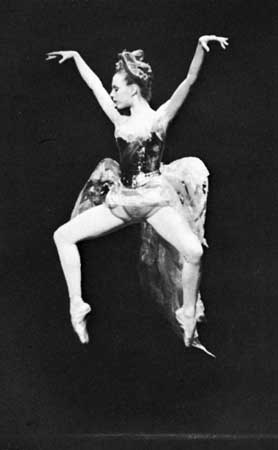
2nd position en pointe, executed by Gelsey Kirkland, in the Firebird. Image from Britanica Online Encyclopedia. Credit Martha Swope

2nd position en pointe, executed by Gelsey Kirkland, in the Firebird. Image from Britanica Online Encyclopedia. Credit Martha Swope

These are two of my passions and I am fascinated by the parallels and similarities between them. Olympic swimming champion Liam Tancock, believes that the poise ballet gives you is important for a swimmer as are the core strength and strong ankles that ballet dancers need.  He took weekly ballet lessons of part of his swimming  training.

In a TV interview he also pointed out that ballet dancers must place their limbs and their hands and feet with great precision. They need to be mindfully aware of the precise, yet moving positions of their bodies at all times.  This kind of awareness is important to elite swimmers where winning or losing can be a matter of hundredths of a second.

I taught one man who had been in the British Army for many years but for some reason had never really learned to swim.

‘Have you ever done ballet?’ I asked him.

We were about to practice some breastroke leg actions and that can be a little bit like standing at the barre in second position. He looked at me quizzically and said, politely, that no, ballet had not been part of his military training.

Despite his lack of dance training he did well and learned to swim a length of the pool. But it got me thinking that if people learn something unusual, something way out of their normal sphere of influence, well, who knows what the result might be.

The water is holding you

stars-in-water photo by Deborah Basket

I sometimes ask the children I teach.

‘What is the most important thing about swimming lessons?’
And they give me all sorts of answers like ‘kicking’, ‘floating,’and other things.
But I say ‘No. Fun. That is the most important thing.’ And they look at me in amazement.
I am always in the water with them which is quite necessary as the pool where I teach is too deep for most of them to stand up and so I have to really keep an eye on them. Some of them have floats but some are quite good at swimming without. Some of them have started off very frightened of the water and I have to spend quite a lot of time un-teaching them, i.e letting them understand that they can absolutely trust me not to make them do anything they don’t want to or that will frighten them.
Some of the adults I teach are good swimmers who may want some help with technique and some are just as terrified as the children but added to that they are embarrassed and sometimes almost ashamed that they can’t swim. Every non swimmer seems to go through more or less the same stages whatever their age.  Most are uncertain about putting their faces in the water and they also find it hard to stretch out and believe the water will hold them. They want to keep their heads out of the water, their knees curled up underneath them and their feet near the floor of the pool. For non-swimmers floating on their backs seems to be the most terrifying thing and it is a lovely stage when you can get the little children to stretch out their arms and legs and trust the water to hold them lying on their backs like little stars.The realisation that they can float without me holding them is often very touching and delightful.
I say to the adults you feel you have to hold on to the water but actually the water is holding you.
Photo of stars on the water by Deborah Brasket from her blog  Living on the edge of the wild 

Mindful swimming

I have called this blog mindful swimming without really explaining what I mean. There are hundreds, even thousands of books, website, blogs, courses, research papers etc on mindfulness, but nothing I can find on mindful swimming. However, lots and lots of the books, pages etc have pictures, drawings, representations of water. Water and mindfulness it seems, go together. To me swimming is an inherently mindful activity.

Swimming is a solitary activity. Although you may be in the pool, lake, river or sea with many others, essentially you are alone when you swim. You are alone with your thoughts and feelings. Your body is as near to weightless as it is possible to experience. You need to concentrate on coordinating your breathing so you need to be aware of the breath entering and leaving your lungs. Swimming is a very rhythmic activity. Swimming lengths in a pool can be an ideal time to meditate.

The children that I teach show me how to be mindful without even realising it. One little boy said to me after he had jumped in that he could feel the water fizzing. He was talking about the air bubbles bursting against his skin. I had never noticed that even though I have jumped and dived into water thousands and thousands of times. Maybe I did notice when I was a child but I had forgotten to feel it. For this little boy it was a new sensation and so he noticed it.

‘My legs are dancing!’

This was from a little boy of about four or five that I was teaching. His Mum is Irish and though he himself doesn’t have an Irish accent he has a kind of Irish inflexion sometimes in the way he speaks. He was nervous of the water and at first didn’t want me to let go of him even though he was using a noodle, a long tube of foam that we use as a buoyancy aid.

But then I think he suddenly felt the sense of weightlessness and freedom of his legs dancing in the water beneath him as he realised that neither the noodle nor the water were going to drop him.

One thing that all new swimmers have to learn is the unusual sensation of the small amount of resistance that the water offers to their limbs. It is more than air, about twelve times as much in fact, but not as much as a solid object. But it is not no resistance at all, it is just a little bit and to swim you have to learn to recognise and use this. It is this that is easier for children than adults. Most adults and children use jerky sudden movements in the water until they have learned the soft fluid, yet strong movements that are needed to propel yourself through the water.

I have learned not to say too much about what exactly one needs to do with the arms and legs as I find, especially with the children, too much instruction can interfere with the learning process. I prefer to let them find their own way then offer a little bit of direction. Some children are incredibly inventive and come up with ideas of their own. It is fascinating to try to understand the way they experience the water. One little boy said to me very seriously

‘The water never stops moving, even at night. ‘

Another one asked me

‘Why are there mountains in the water?’

I was confused at first until he showed me what he was looking at. There were quite a few people in the pool so the surface of the water was rippled and waved. From down at his level close to the surface of the water the waves looked just like a mountain range.

(This little boy also thinks my name is Dave, which is fine.)

‘My experience as a new swimmer’

It seems that sometimes dealing with one fear can affect others. One of my students told me that when his fear of the water left him, so did his fear of dogs. I asked him to write something about this. This is the lovely message he sent me, reproduced here with his permission.

Dear Jane

Thank you for teaching me how to overcome my fear of water and learn how to swim the proper way. You have given me a lot of confidence and you are a fantastic and patient teacher. By learning to swim it has also helped me in many other ways, for example I have self confidence and have over come the fear of dogs too. Again I thank you very much you are absolutely wonderful and I wish you well and will send all my customers to you who want to learn how to swim,

Kind regards

Cyrus Abraham

Shaw Method

I trained with Steven Shaw at Art of Swimming as a Shaw Method teacher at the same time as I was studying for my Amateur Swimming Association level two qualification. Shaw Method is a gentle approach to swimming without strain or stress. It is based on the Alexander Technique

This is what Steven Shaw’s company The Art of Swimming says about the Shaw Method.

Shaw Method applies the principles of  Alexander Technique to swimming. Alexander Technique will teach you to use your body and mind without strain. Put simply, this is what Shaw Method also seeks to achieve, in the water.

Shaw Method teaches greater body awareness, strengthens the relationship between mind and body, promotes freedom of movement, and helps to prevent strain and injury.

I loved the training it was innovative and inspirational. It transformed my own swimming and now when I am swimming in the people often comment on the smoothness and ease of my stroke. I also learned to swim butterfly for the first time in my life. I discovered that using the Shaw Method approach butterfly can be a smooth elegant relaxing stroke.