
Water is the most abundant compound on the planet, covering about seventy percent of the earth’s surface. Wikipedia
swimming science
Did flying evolve from swimming?
When a fish swims it uses two forces. It uses its back fins to create propulsive lift forces and its paddling pectoral fins to create drag to propel forward. An efficient human swimmer also uses both lift and drag. Until recently it was thought that insects rely on lift and redirected lift to fly. But now researchers at Cornell University say they also use drag. This means that in evolutionary terms the transistion from swimming to flying may have been much more straightforward than previously thought.
All flying things whether natuaral or man made create a lift force in order to fly. Lift force occurs when you move an object fast enough throuh any media where the shape of the object creates a difference in speed of the media above and below the object, thus creating a difference in pressure, which causes lift. An insect flaps its wings until it has created enough lift to overcome gravity. In order to move in a particuar direction a part of the lift force is applied to the direction of movement. Until recently it was thought that insects did not use drag to fly only lift. In other words it was thought that insects did not use their wings to paddle through the air like a swimmer paddling through water.
However scientists at Cornell University have recently discovered that some insects do in fact use their front wings to paddle their way through the air, just like a swimmer paddling through water. This paddling creates only drag force and no lift.
I am not completely sure of the physics behind it but I think that when I am working to improve a swimmer’s stroke I am trying to get them to feel ways of using less drag and more lift. I am quite certain that swimming is the closest thing to flying that we can experience and it this research does seem to suggest that flying could have evolved directly from swimming.
The dive reflex
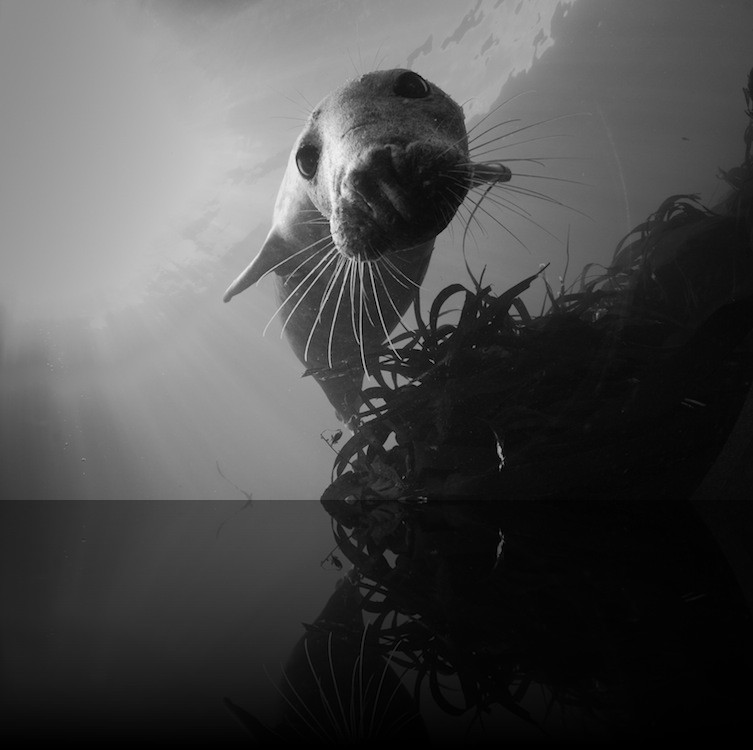
Diving seal, Farne Islands, photo by Farne Island Divers
All mammals, including humans, have a diving response. This consists of three physiological changes in the body:
- The heart rate slows down, by about 10% – 30% sometimes more (with training).
- the blood vessels narrow causing reduced blood flow to the limbs
- on deep dives a blood shift takes place allowing plasma and water to pass into the chest cavity to ensure that the pressure stays constant and the organs are not crushed.
These changes allow the body to tolerate a low level of oxygen. It is the diving response that allows otters, seals and other water mammals to stay under water for a long time. The effect is much less pronounced in humans but it exists. The slowing of the heart rate happens very quickly if you put your face (mouth and nose) into water that is colder than about 21 degrees C. The colder the water the quicker the response.
Photo courtesy of Farne Island Divers
 mindful swimming